
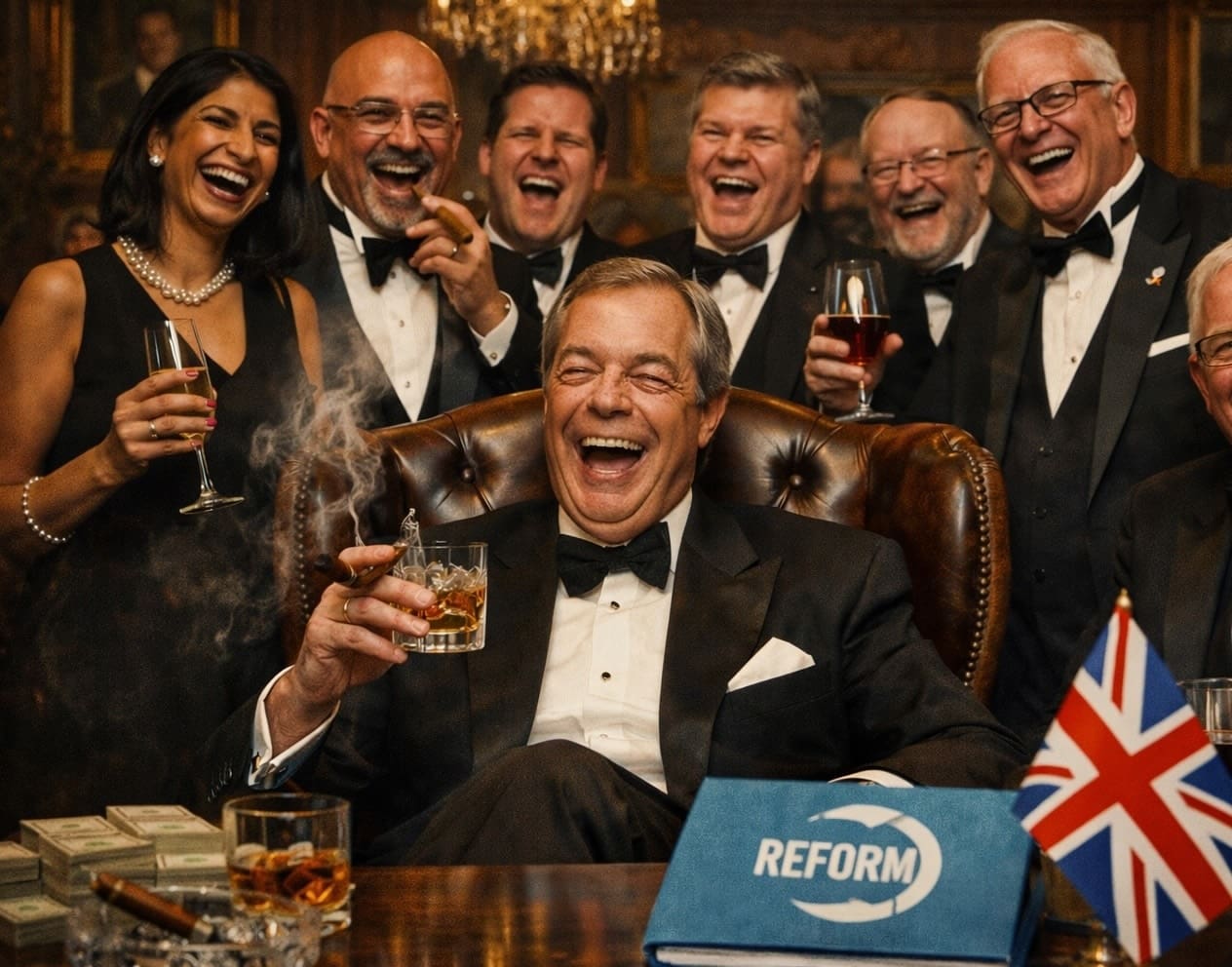
Nigel Farage has spent decades selling himself as the man outside the system – the jolly pub-room insurgent who’d smash the Westminster consensus rather than polish it. But Reform UK is starting to look less like a revolt and more like a political reuse centre. Since the last election, more than 20 former Conservative figures have drifted into the party, blurring the line between rebellion and recycling.
Whats more, many of Reform’s growing Tory intake is not made up of minor backbenchers but senior figures from the centre of Conservative power – politicians such as Suella Braverman, Nadhim Zahawi and Robert Jenrick, all of whom held top-tier roles during the years Reform now brands a national failure. It is difficult to sell yourself as the antidote to collapse while recruiting the people who quite literally signed it off.


The public gaslighting is in full flow, with the ex-Tories now publicly inventing different versions of history in an attempt to distance themselves from their own past. However, recent polls suggest it isn’t going down well with the electorate. Coined, the ‘Braverman effect’ – it could seemingly only be more damaging for Farage and Reform if Liz Truss joins the party.
These aren’t fresh voices or disruptive thinkers. They’re seasoned operators from the same political class that spent 14 years running the country into potholes, spiralling costs and institutional decay. This isn’t a clean break from the past – it’s the past changing its jacket. Reform pitches itself as the ‘alternative’, not a reunion tour for those who helped cause it.
Farage’s Miscalculation
Instead of building momentum, Reform has seen its support contract in successive polls, a sign that its insurgent brand is weakening as voters question what distinguishes it from the parties it hopes to replace.
That contradiction alone would be damaging enough. But it comes at the worst possible time. Reform’s central pitch – immigration – is losing its potency. Labour is now moving decisively to cut numbers and tighten enforcement, draining urgency from Reform’s one-note platform. When the main parties start doing what you claim only you will do, protest politics quickly runs out of road. Early data suggests that immigration figures will show a radical decline in inward migration this year.
The Trump and Epstein Effect
Then there’s the party’s increasingly cosy relationship with the Trump world. Farage has made no secret of his closeness to figures around Donald Trump, presenting it as proof of global relevance and anti-establishment credentials. But that association is starting to look less like an asset and more like a liability. Last week’s remarks from Trump – widely seen as disrespectful to UK armed forces – landed extremely badly with British voters, including many Reform supporters who place patriotism front and centre.
Worse still, the Trump brand is once again being dragged through the mud by the resurfacing of past sex scandals, convictions, and unresolved allegations, reopening questions many thought had been buried. Tying Reform’s image to that orbit risks importing all of the baggage with none of the electoral upside. British voters may tolerate bluntness – but chaos, controversy and moral fog travel less well across the Atlantic.
Whats more, Farage himself has been named in the Epstein files. Interestingly, Steve Bannon, the alt-right mastermind behind Trump’s rise, was recorded bragging about pulling Nigel Farage’s strings. The gap between Farage’s “man of the people” image and the reality keeps getting wider.
Party for the People… Funded by Billionaires
For a party that markets itself as anti-elite, Reform is curiously dependent on elite money.
Research by Democracy for Sale shows around three-quarters of Reform UK’s donations have come from just three very wealthy individuals – including the crypto investor Christopher Harborne, financial backer Jeremy Hosking and former Reform leader Richard Tice – together contributing around £23 million of the roughly £30 million received since 2019.
Investigations from DeSmog have also found that significant portions of Reform’s funding have originated from donors linked to oil and gas, highly polluting industries and climate science denial networks, with one analysis reporting £2.3 million from such interests between 2019 and mid-2024 – accounting for a large share of the party’s declared donations. In fact, up to 92% of the party funding comes from polluters, climate deniers and fossil fuel interests. It’s no wonder that beyond the immigration soundbites familiar with the general public, many of Reform’s policies hinge on environmental deregulation, defunding and tax breaks that will benefit the wealthiest.
Couple that with the fact that ‘man of the people’ Farage has been amassing a personal fortune whilst barely being seen in his constituency of Clacton. It is estimated that he made in excess of £1.1m from a range of roles – including presenting on GB News, brand ambassadorships, paid speeches, personalised videos and other media work. He also curiously attended Davos World Economic Forum last week as an advisor to Iranian businessman Sasan Ghandehari.
Who are the Elites?
Ex-city trader Farage built his career attacking Conservative incompetence and elite failure. Yet he now leads a party increasingly populated by ex-Tory MPs while aligning himself with the US MAGA political movement many in Britain view as extreme, unstable and corrosive. It’s a strange place for an “outsider” to end up. You can’t convincingly rage against the establishment while recruiting it wholesale – or claim moral clarity while borrowing credibility from a movement drowning in scandal.
Optics matter. Trust matters. And Reform is currently haemorrhaging both. This isn’t a party seemingly beginning to slide backwards, weighed down by discarded Conservatives, imported culture wars and borrowed reputations. If this trajectory continues, Reform won’t be remembered as Britain’s great political alternative at all. It will be remembered as a political cul-de-sac: a second-chance holding pen for failed Tories at home and failing politics abroad.
Reform’s recent attacks on the Green Party are also revealing. The Greens have laid down a truly different alternative, and appear to be shooting up the polls. They have carved out a distinct political lane – younger, values-driven and increasingly organised – and Reform’s decision to target them looks less like strategy and more like anxiety. When a party that claims to own the “alternative” space starts lashing out sideways, it’s usually because it can feel that space slipping away.