For months now, a familiar refrain has echoed across social media feeds in the UK: free speech is under attack, shadowy governments are coming for your voice, and only one billionaire tech owner is brave enough to stand in the way. The message is simple, emotive and endlessly repeated. And for a growing cohort of users, it has become an article of faith.
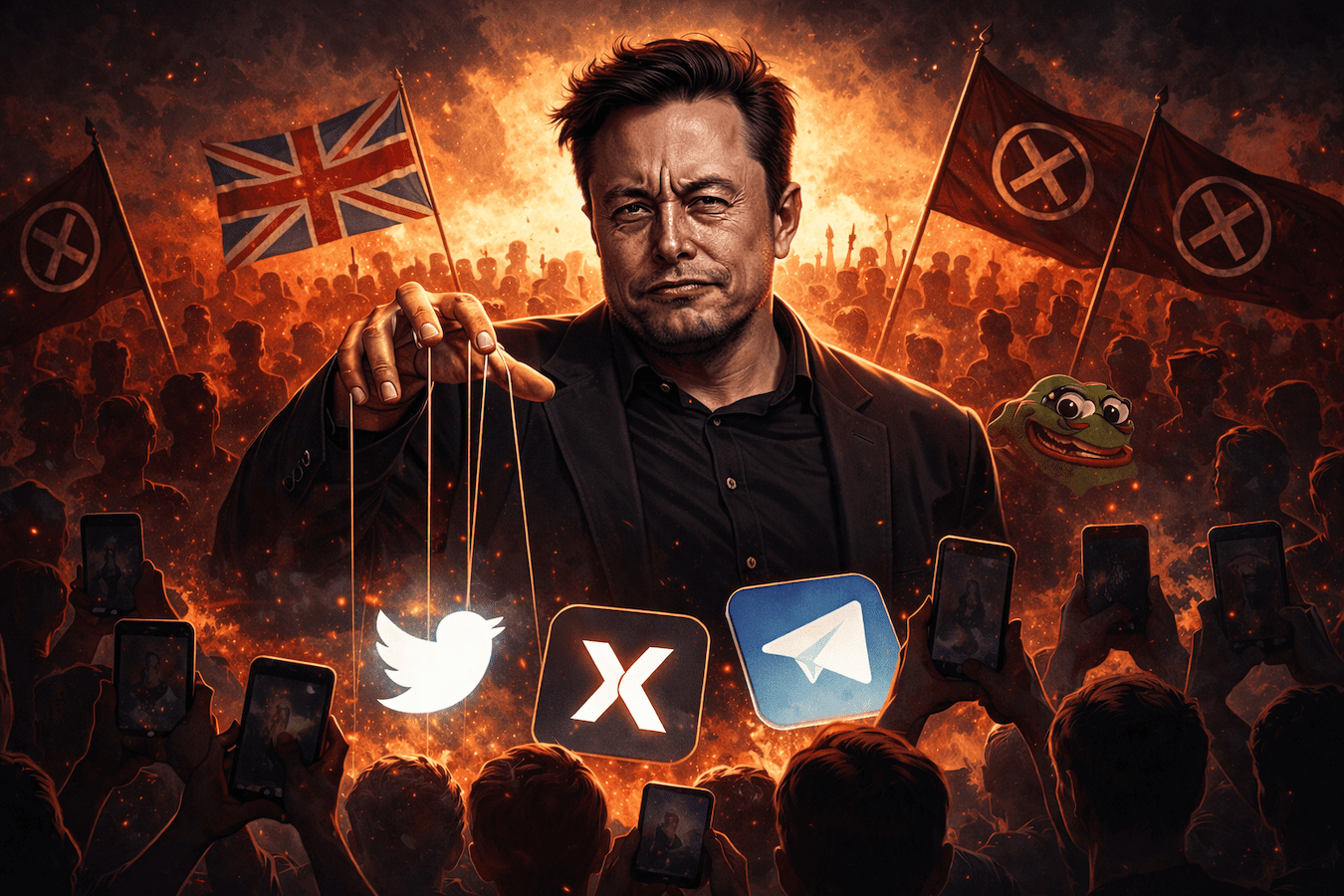
At the centre of this campaign is Elon Musk, recast by his most fervent supporters as a lone defender of liberty. Around him has gathered a loose but vocal “free speech army” – people who insist they are thinking independently while parroting the same talking points, memes and outrage cycles. They see themselves as rebels. In reality, they have become something far less flattering: useful idiots in a global influence game.


The myth of absolute free speech
The central claim pushed by Musk and amplified by his online supporters is that Western democracies, including the UK, are sliding towards authoritarian censorship. Any attempt to regulate social media, protect children online or curb foreign political interference is framed as proof.
Yet this version of “free speech” collapses the moment it meets reality.
On Musk-owned platforms, speech is not free in any meaningful sense. It is curated, ranked, boosted or buried by opaque algorithms designed to maximise engagement, outrage and, crucially, the power of the platform owner. Accounts aligned with Musk’s worldview are routinely amplified. Critics find their reach throttled, their posts deprioritised or their accounts suspended under vague and inconsistently applied rules.
This is not a neutral digital town square. It is a privately owned megaphone, tilted.
Hypocrisy as a business model
The contradiction at the heart of Musk’s crusade is glaring. While he rails against governments for “censorship”, his companies make daily editorial decisions that shape political discourse at scale. He presents himself as a free speech absolutist while banning journalists, suppressing links he dislikes, and altering algorithms in ways that directly influence public debate.
Even more revealing is his reaction to proposed protections for children and young people online.
UK and European efforts to restrict under-16s’ access to addictive platforms, curb the spread of sexualised images, or hold tech firms accountable for harm are not radical attacks on liberty. They are cautious, overdue responses to a system that has demonstrably failed to self-regulate. Yet Musk’s response has been fury, mockery and outright smears against elected leaders who dare to challenge his business model.
Why? Because these measures threaten engagement metrics, advertising revenue and, ultimately, control.
Courting the far right
What has become impossible to ignore is how selectively Musk deploys his outrage. Across Europe, he has shown increasing support and enthusiasm for far-right parties and figures who share one crucial trait: a willingness to leave his platforms largely unregulated, no matter the social cost.
In country after country, politicians calling for child protection, limits on algorithmic manipulation or safeguards against foreign interference find themselves attacked, mocked or smeared on Musk’s platforms. Those who oppose regulation, however extreme their broader politics, are rewarded with amplification, praise and favourable treatment.
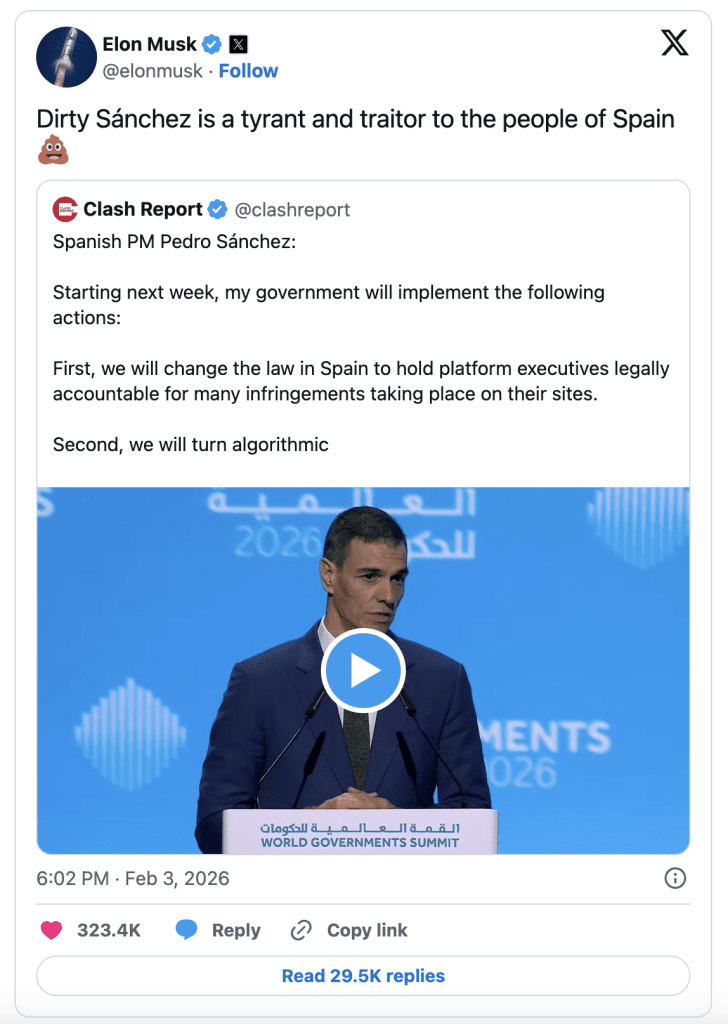
This week, that pattern played out again when Musk launched a public attack on Spain’s prime minister after he vowed to strengthen protections for children online. The offence was not authoritarianism or repression, but the simple act of saying that social media should not be allowed to profit from exposing minors to harmful and sexualised content.
The message was unmistakable: challenge Musk’s freedom to run riot, and you become an enemy of “free speech”. Fall into line, and his algorithmic machinery is happy to look the other way.
The algorithmic power grab
Musk’s desperation to cling to influence is increasingly obvious. Social media platforms are no longer just businesses; they are instruments of political leverage. By tweaking algorithms, promoting certain narratives and rewarding outrage, a single owner can distort national conversations far beyond their borders.
When governments push back against this – particularly when they seek to stop foreign billionaires from interfering in domestic politics – Musk frames it as tyranny. His followers dutifully echo the line, rarely stopping to ask why a self-proclaimed champion of democracy is so hostile to democratic oversight.
The answer is simple: regulation limits power. And Musk has no interest in limits.
The role of the “free thinkers”
Perhaps the most depressing aspect of this saga is the eagerness with which so many UK users have embraced the role assigned to them.
They insist they are sceptics, contrarians, independent minds. Yet their timelines are indistinguishable from one another: the same culture-war obsessions, the same attacks on “the mainstream media”, the same blind defence of a billionaire who would not notice their existence if they vanished tomorrow.
They rail against “elites” while doing unpaid PR for one of the richest men on Earth. They sneer at “sheep” while being herded by algorithmic incentives designed to keep them angry, engaged and predictable.
This is the true function of Musk’s free speech army. Not to defend liberty, but to launder power – to make the consolidation of influence by a private individual look like a grassroots rebellion.
Seeing the game clearly
None of this is about protecting open debate. It is about control: over platforms, narratives and politics. Musk’s rhetoric is a shield, not a principle. And the people repeating it are not resisting authoritarianism – they are enabling a new, privatised version of it.
The tragedy is that genuine concerns about free expression, media trust and political transparency are being weaponised by someone whose interests run in the opposite direction. In swallowing the myth wholesale, his supporters have surrendered the very scepticism they claim to value.
Free speech is not threatened by age limits, child protection laws or democratic oversight. It is threatened when a single, unaccountable actor can decide which voices are heard, which are silenced, and which are amplified to radicalise others.
The sooner Musk’s UK fanbase recognises the role they have been playing, the better. Until then, the free speech army will continue marching – not towards liberty, but in service of a man who sees them as nothing more than a means to an end.