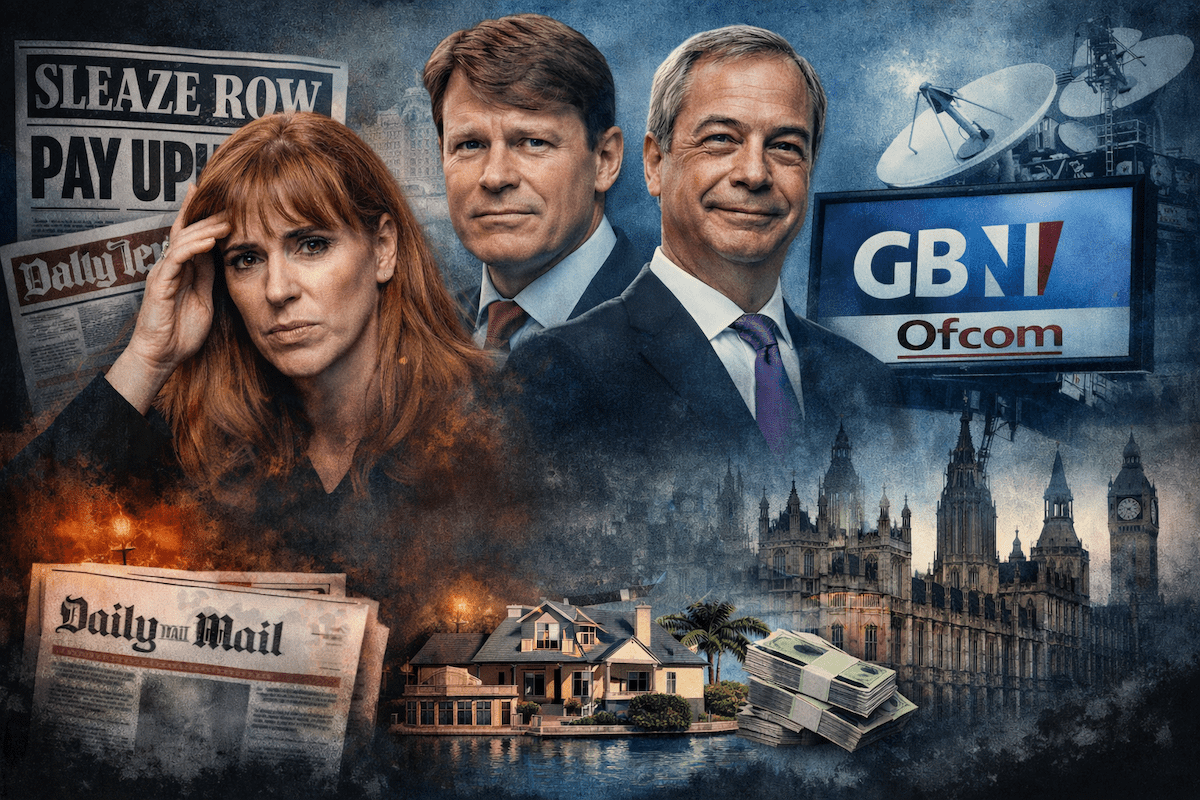
When Angela Rayner admitted she had underpaid stamp duty on a property purchase, the reaction from parts of the British media and political right was swift, coordinated, and relentless.
Within days, she had referred herself to the standards adviser, faced a barrage of front pages, and ultimately resigned. The error, around £40,000 on a complex property arrangement involving a trust for her disabled son, was framed not just as a mistake, but as a moral failure.


The outrage was total. The language was unforgiving. The verdict, pre-determined.
And yet, when similar, or arguably more serious, questions arise elsewhere, the noise fades to a whisper.
The Richard Tice Question
Take Richard Tice, deputy leader of Reform UK and a frequent moralising voice on tax and “fairness”.
Recent reporting has raised questions about his business affairs, including:
- Allegations his company avoided nearly £600,000 in corporation tax
- A separate issue involving around £91,000 in unpaid tax before dividends were distributed
- Links to offshore structures, including a trust in Jersey
Tice has described these issues as “technicalities” or administrative matters, insisting everything was ultimately lawful.
Perhaps. But that defence sounds remarkably familiar.
It is, after all, not far removed from Rayner’s own explanation: a complex system, professional advice, and a mistake corrected once identified.
The difference? One triggered wall-to-wall outrage. The other… barely a murmur.
The Farage Property Puzzle
Then there is Nigel Farage, Reform’s figurehead and one of the loudest critics of Rayner at the time.
Farage publicly claimed he had bought a house in Clacton, his constituency, presenting it as proof of local commitment. He later admitted that was not true: the property was in fact purchased solely by his partner.
Why does that matter?
Because had Farage personally bought the property, he could have been liable for significantly higher stamp duty as a second-home owner.
That raises obvious, unresolved questions:
- Who provided the funds?
- Was the structure designed to reduce tax liability?
- Would the same arrangement be treated differently if scrutinised with the intensity applied to Rayner?
Farage has rejected suggestions of wrongdoing, and no authority has found any breach of rules. But crucially, these questions have never been fully answered in public.
Even more striking is the response from within his own party. Tice dismissed scrutiny of Farage’s tax affairs as “irrelevant” to voters.
That’s a remarkable position for a movement that had, days earlier, insisted tax conduct was a matter of public integrity serious enough to end a political career.
Media Outrage , Selectively Applied
This is where the role of outlets like Daily Mail and GB News becomes impossible to ignore.
During the Rayner episode:
- Saturation coverage
- Loaded language (“sleaze”, “hypocrisy”, “dodging tax”)
- Constant calls for resignation
But on Tice? Limited or no attention.
On Farage? Almost no coverage and minimal follow-up.
The contrast is not subtle, it is structural.
And it goes deeper than editorial choices. There is a growing body of criticism that GB News is no longer merely sympathetic to Reform, but effectively aligned with it. One recent investigation found the channel has drifted into functioning as “Reform TV”, with repeated breaches of impartiality rules and a regulator that has struggled, or failed, to rein it in.
Ofcom itself has found GB News in breach of its broadcasting code multiple times, yet enforcement has been inconsistent, and in some cases rulings have been overturned or dropped. (The Independent)
When the platform amplifying outrage is so closely intertwined with the political movement driving it, the imbalance in scrutiny starts to look less accidental, and more systemic.
The Real Issue: Consistency
None of this is to argue that Rayner should not have faced scrutiny. She should have, and she did.
But accountability only has meaning if it is applied consistently.
If underpaying tax, even accidentally, is grounds for resignation, then:
- Why are similar or larger sums treated as “technicalities” elsewhere?
- Why are complex financial arrangements condemned in one case, but shrugged off in another?
- Why is one politician’s explanation unacceptable, while another’s is taken at face value?
These are not partisan questions. They are questions about standards.
A One-Way Moral Test
What emerges is a pattern:
- Labour error → scandal, outrage, resignation
- Reform controversy → explanation, minimisation, silence
It is not just hypocrisy from politicians. It is amplification by media ecosystems that choose when to be outraged, and when not to be.
The Rayner affair demonstrated how quickly political careers can unravel under sustained scrutiny.
It’s obvious to anybody working in the media, but perhaps not the general public, that most of the media is owned by wealthy right-leaning individuals. Of course they seek to influence public discourse. However, the silence around this story exposes something deeper: a selective application of outrage that undermines the very idea of accountability.
If tax conduct is a test of integrity, then it must be a test for everyone. Not just for the people it is convenient to target. And are we really satisfied with a partisan US style media in the UK, where reality depends on which media you absorb? If not, a toothless regulator will certainly not reverse this trend.