
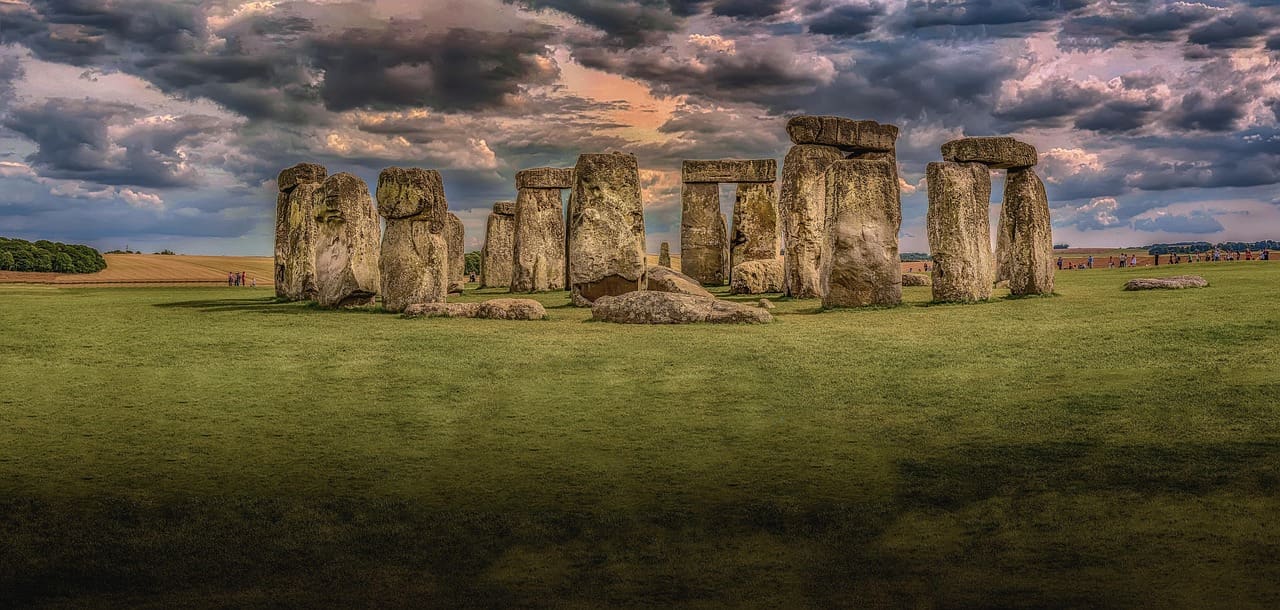
Scientists have failed to match Stonehenge’s six-tonne Altar Stone to any site in Scotland’s Orcadian Basin, undermining the theory that it was dragged to Wiltshire from the far north.
The findings come from a team led by Professor Duncan Pirrie of the University of South Wales. The BBC reported that the work is the most thorough geological examination of the stone yet carried out.


The Altar Stone is a 4.9 metre slab of sandstone that now lies flat inside the monument, partly buried beneath the collapsed Great Trilithon and its lintel. Phys.org reported that it sits sunk into the turf under the fallen stones.
How the theory changed
For about a century, the stone was believed to have come from Wales. Later research cast doubt on that, and a 2024 study in the journal Nature pointed instead to the Orcadian Basin in north east Scotland, roughly 750km away.
That Nature paper used the age and make-up of mineral grains in the sandstone to link it to the basin. Its authors said at the time that the basin was a large area and that more work was needed to find the exact spot.
The new team set out to do that. According to the BBC, they tested rocks in the Orcadian Basin and found no location sharing the characteristics of the Altar Stone.
What the researchers did
The scientists made fresh observations of the stone itself. They also studied fragments of it held in museum collections.
They examined its structure, its minerals, its chemical composition and its isotopic signature. Hello Rayo reported that the team says none of the places examined so far has the same set of characteristics.
The paper has appeared in the Geological Society’s journal. Its title refers to new sedimentological, petrographical, mineralogical, geochemical and isotopic constraints on the stone’s origin.
The researchers say the detailed fingerprint they have built should help identify the source in the end. Several previously proposed locations have also now been ruled out, according to Phys.org.
Professor Pirrie said the work had left the team “far better equipped to focus on the areas most likely to yield an answer”. He described it as the most comprehensive geological investigation of the Altar Stone ever undertaken.
Professor Nick Pearce of Aberystwyth University, who worked on earlier research into the stone, said that “ruling out potential source areas is just as important as identifying new ones”.
Pearce, a geochemistry expert, said each location eliminated narrows the hunt. He added that finding the source would give valuable insight into how the stone reached Salisbury Plain.
The Altar Stone stands apart from the rest of the monument, which was built in several phases between 3000 and 1600BC. Stonehenge’s smaller bluestones were brought from west Wales, about 225km away.
For now, the researchers say the Altar Stone’s home remains unidentified, and the search will continue.
Sources: Phys.org, Hello Rayo, Al Jazeera, BBC News
This story was compiled by the MDW Newsdesk with AI-assisted tools, using the reporting credited above.