

The Atlantic currents or Atlantic Meridional Overturning Circulation (AMOC) is often described as a giant ocean conveyor belt. A vast system of currents in the Atlantic Ocean that transports warm, salty surface water northward toward the North Atlantic and cold, deep water southward toward the tropics. It is a cornerstone of the global climate system, playing a central role in redistributing heat, regulating weather patterns, and supporting marine ecosystems. Recent research suggests that the AMOC has been weakening over the past century, and this slowdown could have profound implications for regional and global climates in the decades ahead.
What Is the AMOC and How Does It Work?
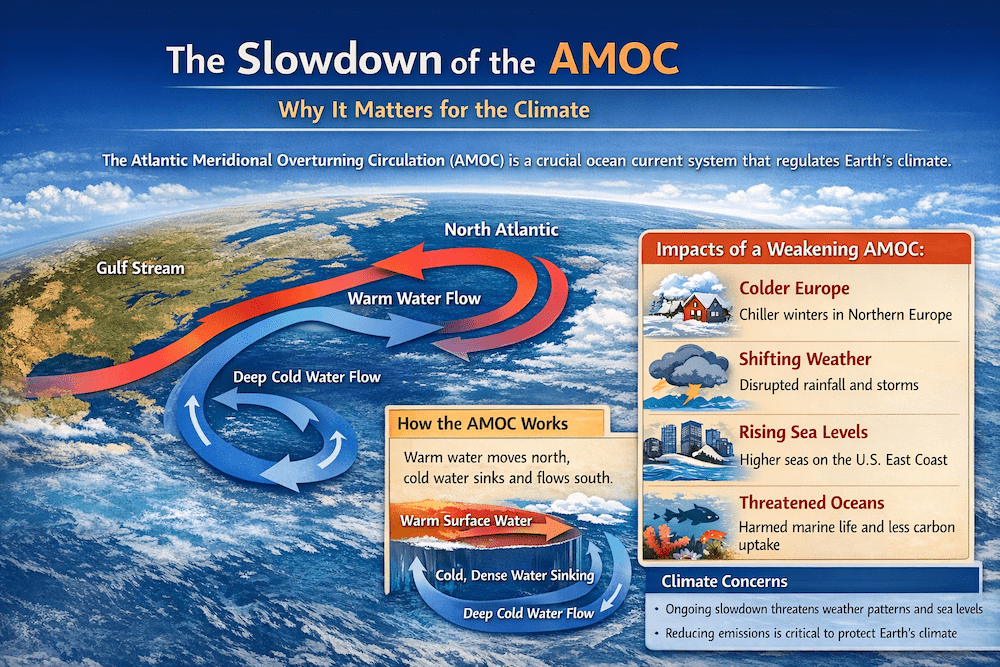
At its simplest, the AMOC works by moving water around the Atlantic much like a conveyor belt, warm surface water flows northward from the tropics, bringing heat to higher latitudes, and cold, dense water sinks and returns southward at depth. This circulation is driven by differences in water temperature and salinity, a process sometimes called thermohaline circulation. When warm water cools near the Arctic, it becomes saltier and heavier, causing it to sink and flow back toward the tropics deep beneath the surface.


This system transports enormous amounts of heat, roughly equivalent to 1.2 petawatts, which is about 100 times greater than global energy production. That heat transport helps keep Europe and the North Atlantic region milder in winter than other regions at similar latitudes, such as parts of Canada or Russia.
Evidence of a Slowdown
Climate scientists have pieced together evidence that the AMOC has been losing strength over the past century. Direct measurements, available since 2004, show natural year-to-year variability, but longer trends are inferred from multiple lines of evidence including sea surface temperatures, salinity records, and climate models. These suggest a long-term weakening trend likely linked to human-caused climate change.
One primary driver of this slowdown is the influx of fresh water from melting ice sheets (especially Greenland) and increased rainfall in the North Atlantic. Fresh water reduces the salt content of surface waters, making them lighter and less prone to sinking, the very process that propels the AMOC. As a result, the “engine” of the overturning circulation weakens.
Why a Weaker AMOC Matters
The importance of the AMOC lies in its climate-regulating functions. A weakened circulation could alter atmospheric and oceanic systems in several critical ways:
1. Regional Climate Shifts
A slower AMOC means less heat transported northward, which could cool parts of the North Atlantic region, especially northwestern Europe and here in the UK, even as the planet as a whole warms. This counterintuitive effect arises because the delivery of tropical heat to northern latitudes would diminish, making winters colder and summers more volatile.
2. Changes in Weather Patterns and Rainfall
The AMOC influences atmospheric circulation patterns globally. A slowdown could shift storm tracks, disrupt monsoon systems (such as the Indian monsoon), and change the distribution and intensity of rainfall in sensitive regions like West Africa, the Amazon basin, and the Caribbean. Lower rainfall in the Amazon could stress rainforest ecosystems, potentially turning them from carbon sinks into carbon sources.
3. Sea Level Rise and Coastal Impacts
Changes in ocean circulation affect sea levels. A weaker AMOC can elevate sea levels along parts of the US East Coastand elsewhere due to redistribution of ocean water and heat. Warmer water also expands, further raising sea levels and exacerbating coastal flooding risks.
4. Ocean Ecosystems and Carbon Uptake
The AMOC also helps transport nutrients and carbon through the ocean. A slowdown could reduce nutrient supply to surface waters and alter ecosystems, harming fisheries and marine biodiversity. Moreover, less deep water formation may weaken the ocean’s ability to absorb carbon dioxide from the atmosphere, leaving more greenhouse gases in the air.
Is a Collapse Likely?
Some early research raised alarm about a full collapse of the AMOC. An abrupt shut-down with catastrophic consequences. While past climate events, including abrupt cooling periods, are linked to AMOC collapse, most contemporary climate models suggest a complete collapse this century is unlikely but this is an ever changing picture. Instead, they indicate a significant weakening is more probable, with substantial impacts on heat transport and weather systems.
However, uncertainties remain. Observational evidence and models differ in how close the system is to a potential tipping point, and scientific debate continues on how sensitive the AMOC is to freshwater forcing and warming.
What Does This Mean for Climate Action?
Even without a dramatic collapse, the ongoing slowdown of the AMOC is a serious concern. Its impacts on regional climates, weather extremes, sea levels, and ecosystems underscore the interconnectedness of Earth’s climate system and the cascading effects greenhouse gas emissions can have far beyond temperature rise alone. Reducing emissions, protecting ice sheets, and improving climate resilience are all vital to minimising further weakening of this critical circulation.
In a warming world, the AMOC’s decline is a stark reminder that climate change does not just mean gradual warming, it means disrupting fundamental processes that have shaped Earth’s climate for millennia.