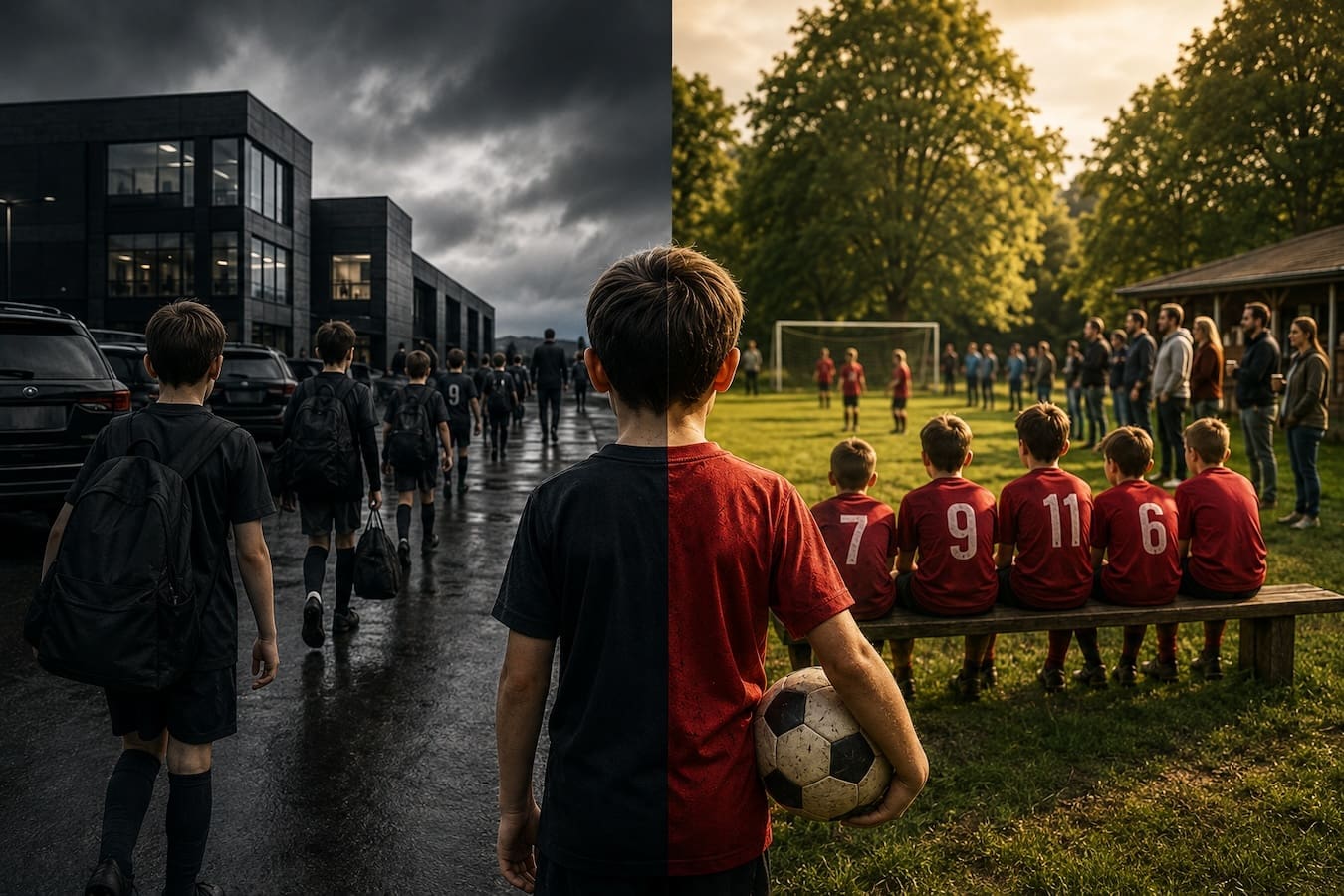
For generations, football belonged to the community.
Every Saturday morning, children would pull on the colours of their local club, meet up with school friends, play on muddy pitches, and hand over a couple of pounds to cover the referee. Parents ran the tea hut. Volunteers marked the pitches. Coaches gave up their weekends because they loved the game.


It wasn’t glamorous, but it produced something that is becoming increasingly rare: lifelong friendships, thriving communities, and a genuine love of football.
Today, that model is disappearing.
In its place is an industry.
Across Britain, privately-run football academies have sprung up promising “elite coaching”, “professional pathways” and opportunities to be spotted by scouts. Parents are sold the dream that, with enough training sessions, specialist camps, one-to-one coaching and expensive tours, their child might be the next Premier League star.
For many families, that dream comes with a staggering price tag.
The Cost of Chasing the Dream
Parents are now routinely paying:
- £40-£100+ per month for academy membership.
- £30-£70 for holiday camps lasting just a few hours.
- £40-£100 an hour for private coaching.
- Hundreds of pounds for showcase tournaments.
- Expensive branded training kits.
- Travel costs to tournaments and training centres.
- Goalkeeping specialists, strength coaches and nutrition sessions.
It is no longer unusual for committed families to spend several thousand pounds a year on youth football.
Multiply that by hundreds of children at a single academy and it becomes clear why football has become a highly lucrative business.
None of this is to criticise good coaches. There are thousands of dedicated people helping children improve.
The question is whether the industry is selling hope that simply cannot be delivered.
The Odds Nobody Wants to Talk About
Every academy brochure features smiling children wearing professional club shirts.
Social media is filled with videos of scouts attending tournaments.
Parents naturally ask themselves:
“What if my child is the one?”
The uncomfortable reality is that the chances are vanishingly small.
The overwhelming majority of children – even those in professional club academies – will never become professional footballers.
Many youngsters who spend years inside Premier League and Football League academies are released before reaching adulthood. Even among those retained through the youth system, only a tiny proportion go on to make a sustained living in the professional game.
Only around 180 out of 1.5 million boys playing organised youth football in England will eventually play in the Premier League. That equates to 0.012%, or roughly 1 in 8,300 children.
To put that another way, there is a 99.988% chance that your child won’t become a Premier League player. Let alone a player that sustains a long and successful career.
Yet countless private academies market themselves around “pathways” and “opportunities” despite knowing that almost every child attending will never follow that route.
Hope sells.
And hope is profitable.
The Hidden Cost Isn’t Financial
Perhaps the greatest tragedy isn’t the money.
It’s what children lose while chasing a dream.
Instead of growing up alongside the same teammates year after year…
Instead of representing their village or town…
Instead of building friendships that last decades…
Children increasingly drift between elite programmes, development centres, invitation-only squads and private training sessions.
If they don’t make the cut, many simply stop playing altogether.
Football becomes something they failed at.
Not something they loved.
How many talented 16-year-olds have walked away from the sport entirely because they were released from an academy or overlooked for the next “elite” squad?
If football is presented as an audition rather than a pastime, rejection becomes an ending instead of merely another chapter.
Grassroots Clubs Are Paying the Price
Across the country, grassroots clubs report increasing difficulties recruiting players.
Volunteer coaches struggle to fill squads.
Traditional youth leagues have shrunk in many areas.
Meanwhile, children who might once have strengthened local clubs are training elsewhere in fragmented academy programmes.
Ironically, veterans football is thriving.
Adult players in their 30s, 40s and 50s continue to turn out every week – not because they believe they’ll be signed by Arsenal – but because they enjoy football, friendship and belonging.
They understand something that children are increasingly in danger of forgetting.
Football was never supposed to be just a career path.
It was supposed to be fun.
Community Is Worth More Than a Scout’s Business Card
Ask adults what they remember most about youth football.
Very few mention trophies.
Almost nobody talks about technical drills.
Instead they remember:
- The away trips.
- The changing-room jokes.
- The muddy pitches.
- The coach who believed in them.
- The teammates they still see 20 years later.
Those memories were built through community clubs.
Not commercial training centres.
Football has always been about far more than producing professionals.
It builds confidence.
Keeps children active.
Teaches teamwork.
Creates friendships across different schools and backgrounds.
Strengthens communities.
These are extraordinary outcomes—even if nobody signs a professional contract.
Is Football Forgetting What Success Looks Like?
The measure of youth football should not be how many professionals it produces.
It should be how many children are still playing at 18.
How many are still playing at 28.
How many are coaching their own children at 38.
If a system encourages thousands of youngsters to give up because they weren’t selected, perhaps it isn’t succeeding at all.
Perhaps it’s failing the very people it claims to serve.
Time to Take Football Back?
Private academies undoubtedly have a place for exceptionally talented youngsters who genuinely need additional development.
But they should complement grassroots football – not replace it.
Parents should ask themselves a simple question:
Would my child be happier spending every Saturday with local friends, representing their community, making memories and developing a lifelong love of the game…
…or spending thousands of pounds chasing odds that are measured in fractions of one percent?
Football’s greatest success has never been creating Premier League stars.
It’s creating millions of people who love the game for life.
Perhaps it’s time we stopped selling children the dream of becoming professional footballers – and started reminding them that simply playing football is already one of the greatest victories of all.