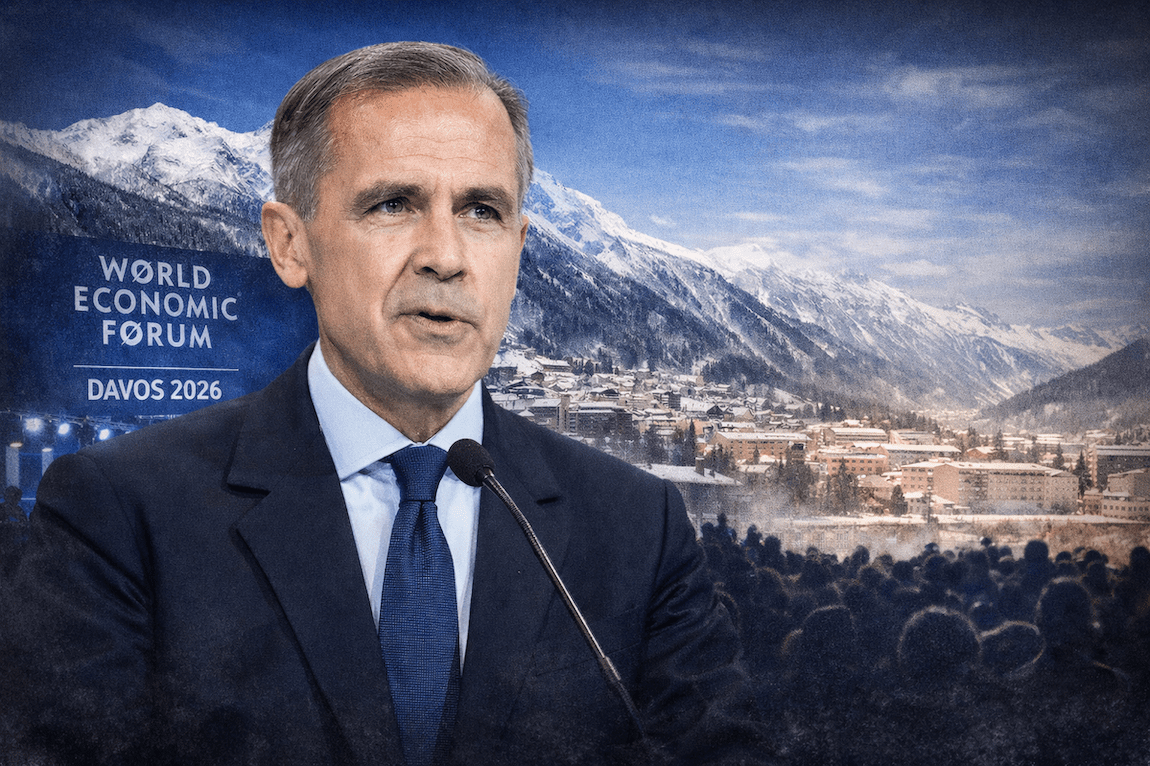
This week, Mark Carney, Canada’s Prime Minister, delivered a speech at Davos that should make the UK sit up and take notice. With his trademark clarity and pragmatism, Carney laid out a stark warning: the old world order, the U.S.-led rules-based system that has defined global politics for decades, is not coming back. Instead, we are in the midst of a rupture, a fracture that demands both strategic realism and domestic resilience.
Carney’s argument is simple yet profound. For decades, middle powers like Canada could rely on predictable alliances and economic integration to protect their interests. But those days are fading. Trade relationships can be weaponised, supply chains manipulated, and institutions that once guaranteed stability now struggle to restrain great powers. In this new reality, nostalgia is not a strategy; adaptation is.


Canada’s response, as Carney outlined, is twofold. First, it is building economic resilience at home, investing in critical sectors, diversifying trade and strengthening supply chains. Second, it is forging coalitions with like-minded middle powers to ensure it is “at the table, not on the menu.” Pragmatic, adaptive, and forward-looking, this approach blends principle with practicality.
The UK has long prided itself on its global influence, but Carney’s message is a sobering reminder that influence alone is not enough. Post-Brexit, the UK is navigating a complex international landscape, attempting to assert its independence while maintaining strategic partnerships. Carney’s insights underscore the importance of diversification in this new world. Over-reliance on a single ally, whether the U.S. or the EU, is a vulnerability the UK cannot afford. Strategic diversification is essential not just in trade, but across energy, technology, critical minerals, defence, and finance.
Domestic resilience, Carney argues, is inseparable from international strategy. The UK must recognise that strong, adaptable domestic structures empower it to act decisively on the global stage. Investments in innovation, infrastructure, and critical industries will not only secure economic growth but also provide strategic leverage. In an era where supply chain disruptions, technological competition, and economic coercion are increasingly tools of power, resilience becomes a form of national security.
Multilateralism also requires a fresh perspective. Carney’s speech highlights the limitations of existing international institutions in restraining powerful states. For the UK, this signals a need for pragmatic engagement.Working within global frameworks where they remain effective, while also reforming and innovating where they fall short. Being part of coalitions of like-minded nations allows middle powers to punch above their weight, ensuring that rules and norms are upheld even as the traditional order erodes.
Moreover, Carney’s call to action emphasises flexibility. The UK should avoid rigid allegiances that can constrain policy or economic manoeuvrability. Instead, a more dynamic approach, forging partnerships based on issues, sectors, or shared strategic interests will allow the UK to remain influential even in an unpredictable geopolitical environment. This approach also reduces the risk of being sidelined by rapidly shifting global alliances.
The implications of Carney’s analysis extend to climate, technology, and security policy. As the UK pushes its net-zero agenda, invests in AI and digital infrastructure, and recalibrates defence commitments, each of these decisions must be made with the understanding that global power structures are fluid. Building capabilities at home enhances credibility abroad and strengthens the UK’s negotiating position in international forums.
In essence, Carney’s Davos speech is both a warning and a roadmap. The UK cannot afford to cling to the certainties of the past, hoping that the old order will magically return. Instead, it must embrace a dual strategy: fortifying its domestic foundations while engaging globally with flexibility, pragmatism, and purpose. Economic resilience, strategic diversification, and adaptive multilateralism are no longer optional — they are essential to preserving influence and protecting national interests.
The world has changed, and the UK must change with it. Carney’s insights offer a timely and compelling framework for navigating this new reality. The alternative is stark: without strategic foresight, the UK risks being sidelined, unable to assert its interests or safeguard its prosperity in a fractured global order. The time for action is now.